The “Console War” is a seminal concept that has characterized the gaming industry for over four decades. Originating as a competition for market share in the late 1970s, it has evolved into a complex geopolitical struggle for digital ecosystems, cloud infrastructure, and intellectual property. This analysis examines the historical trajectory of console competition from Atari’s early influence to the AI-integrated landscape of 2026.
The Foundational Era: Market Entry and Competition (1977-1983)
The initial phase of competition was defined by the Atari 2600, which established the importance of software libraries over hardware alone. Competitors such as Intellivision and ColecoVision attempted to disrupt this dominance through superior graphical specifications. However, systemic issues in quality control culminated in the industry recession of 1983, necessitating a fundamental restructuring of the market.
The 16-Bit Paradigm: Strategic Brand Differentiation
The 1990s featured a significant rivalry between Nintendo and Sega, marked by aggressive marketing strategies. Sega successfully positioned its hardware as a technologically advanced alternative to Nintendo’s established market presence. This competitive pressure accelerated innovation, resulting in significant advancements in processing power and graphical rendering techniques.
Technological Disruption and Market Expansion
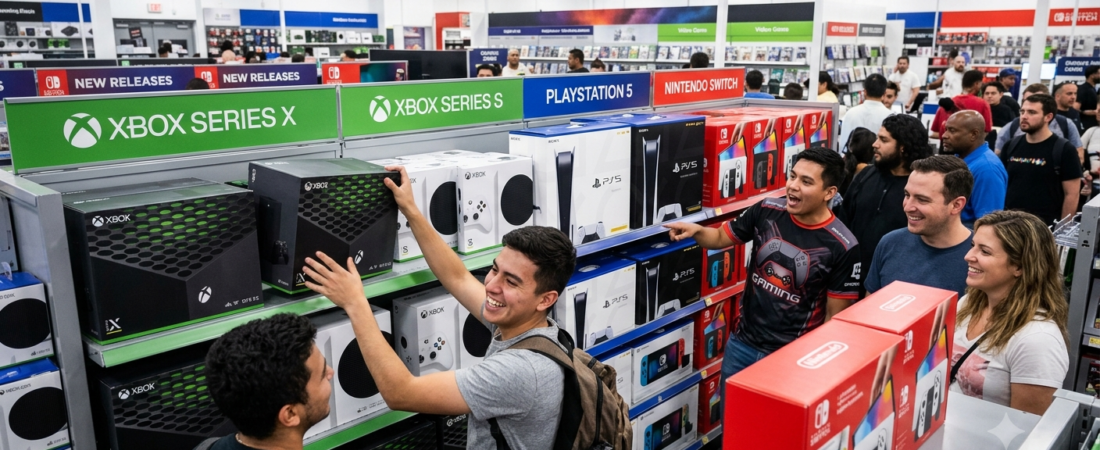
The introduction of the Sony PlayStation in 1994 represented a major technological shift toward optical media and broader demographic targeting. Subsequently, Microsoft’s entry with the Xbox platform integrated PC-based architecture and pioneered the transition to centralized online services. For current market evaluations, refer to our comprehensive guide on the best gaming consoles in 2026.
2026: Ecosystem Integration and Artificial Intelligence
In the current landscape of 2026, competition has shifted from hardware specifications to service-based ecosystems. Sony’s focus on high-fidelity exclusive content competes with Microsoft’s subscription-based model, which leverages cloud infrastructure to minimize hardware dependency. Concurrently, Nintendo maintains its market position through unique hardware-software integration. The sector is now defined by AI-driven procedural generation and cross-platform synergy. Understanding the PlayStation vs. Xbox rivalry is essential for strategic consumer decision-making.
Conclusion: Market Evolution and Consumer Benefit
As the industry moves toward 2030, traditional competitive boundaries are dissolving into a unified digital landscape. While brand loyalty persists, the ultimate beneficiaries are the consumers, who now possess unprecedented access to high-quality content across diverse hardware platforms. For historical context, review our analysis of retro gaming systems.
留下回复